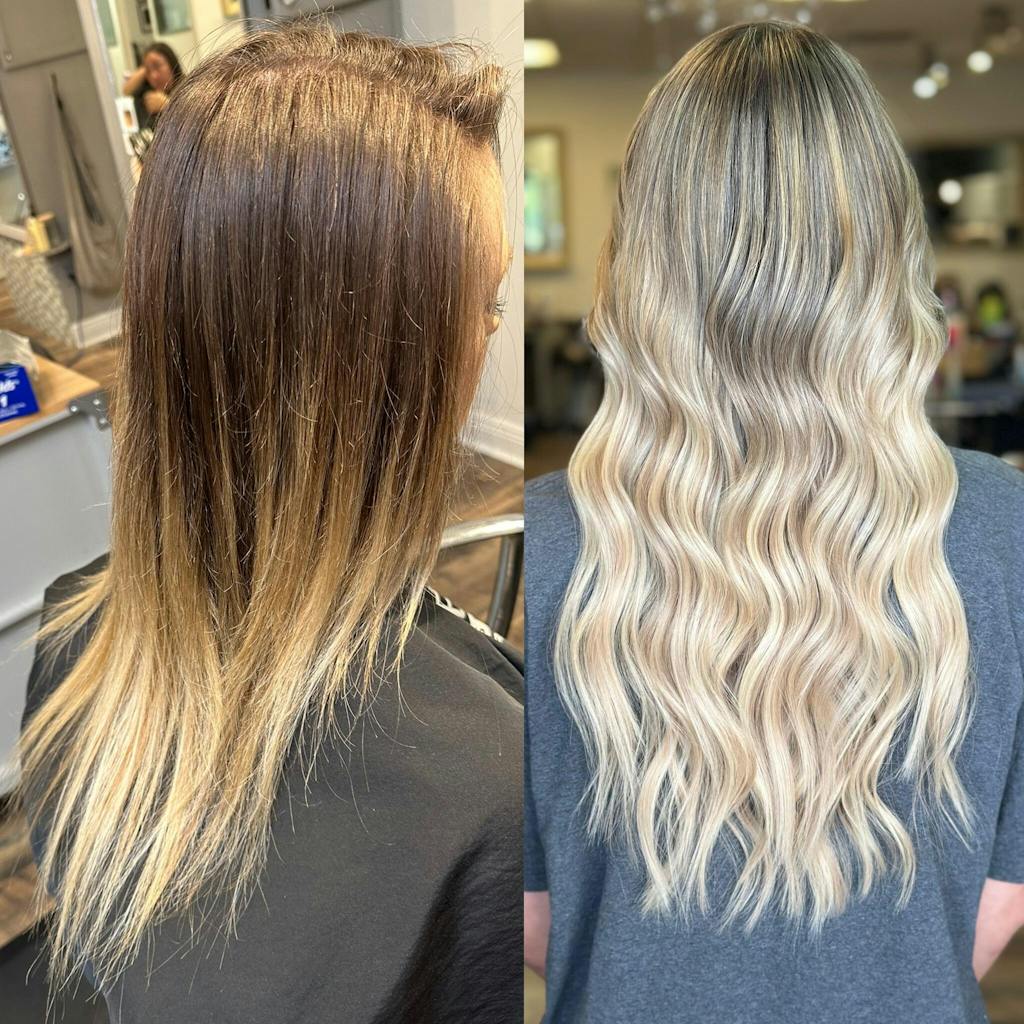
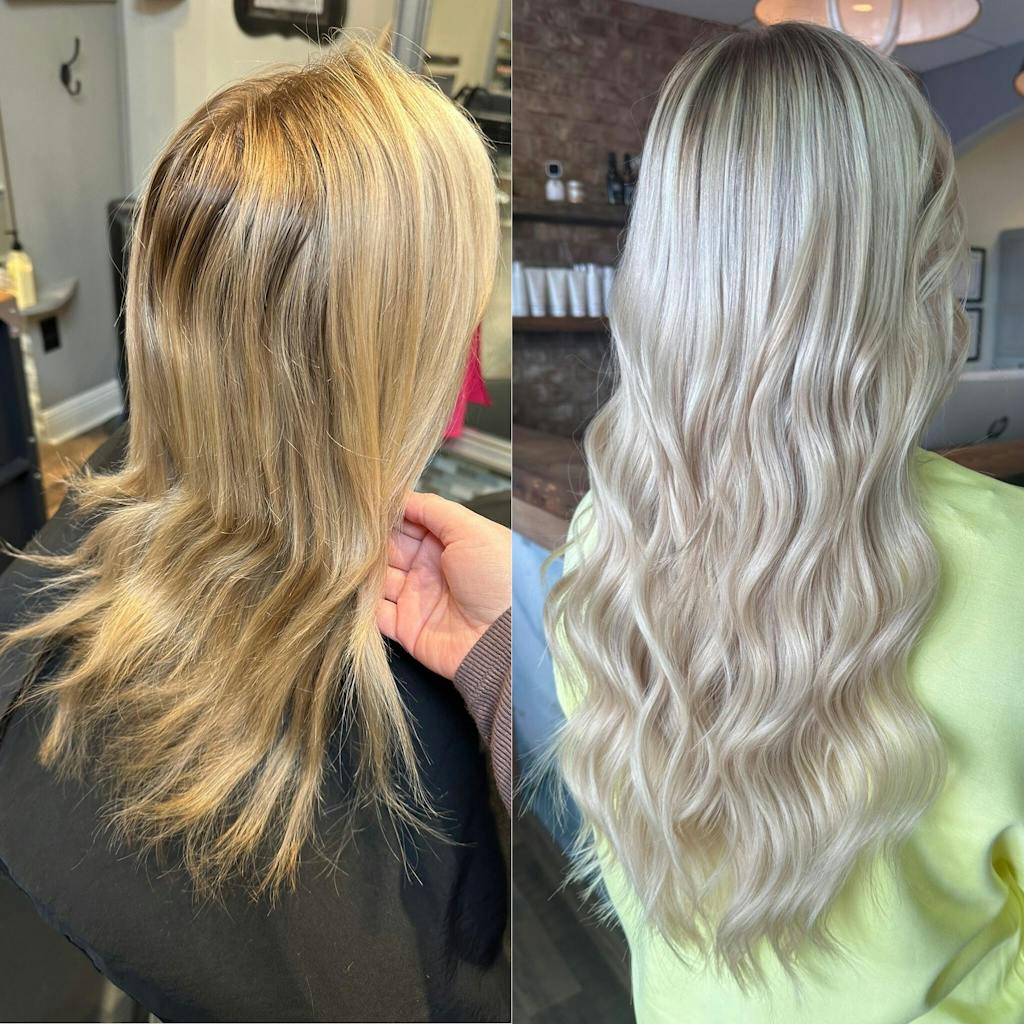
Toning hair extensions is a very common and often necessary process to achieve a perfect color match and eliminate unwanted too warm or too cool undertones, so it's all about caution and technique.
Hair Extensions are an investment and you don't want to see your gorgeous, expensive hair, turned to muddy straw because someone slapped on purple shampoo or toner without understanding what they were working with.
Extensions aren't like your natural hair. Period. And if you treat them the same way, you'll destroy them.
Even with the high-quality extensions, we see this happen all the time: pieces that looked flawless six weeks ago, now sporting a greyish-purple cast that screams, ‘I JUST toned "
Let's fix that.
The Porosity Reality Check: Why Extensions Are Different
Here's the science you actually need to understand.
Your natural hair grows from a healthy follicle with an intact cuticle, those tiny overlapping scales that protect the hair shaft like shingles on a roof. When cuticles lie flat, hair reflects light, feels smooth, and resists absorbing product too quickly.
Extensions? Completely different story.
Most hair extensions, even high-quality ones, have been through industrial processing before they ever reach your head.
Your natural hair is a brand-new sponge; it absorbs product slowly and evenly.
Extensions are a dried-out, weathered sponge; the second any liquid touches them, they gulp it down instantly and unevenly.
This is what we call high porosity.
And this is exactly why your purple shampoo turned your beautiful blonde extensions into a muddy grey mess in thirty seconds flat.
Over-Toning (Turning them Pink/ Purple/Gray/Blue): Hair extensions, especially blonde ones, are often more porous than natural hair because they have been chemically processed.
This means they absorb color much faster. Leaving a purple shampoo or toner on for too long can quickly lead to an undesirable purple, gray, or blue tint that is very difficult to remove. extension didn't "need more time."
It grabbed every bit of purple pigment immediately.
Understanding extension porosity isn't optional; it's the foundation of proper hair extension care.
The Veteran's Method: How We Safely Tone Extensions
After a decade in the field, here's the exact protocol I use. No shortcuts. No exceptions.
Step 1: The Water Buffer
Why this matters: Water partially fills the hair shaft, reducing how much toner the hair can absorb. You're evening out the porosity before introducing pigment.
What to do:
Thoroughly saturate the extensions with lukewarm water before applying any toner. I mean dripping wet.
Remember the sponge analogy? A dry sponge absorbs everything instantly and unevenly. A damp sponge absorbs slowly and evenly.
When toning blonde extensions, you want the wet sponge effect. This gives you control. It gives you time to see what's happening before the color grabs too deep.
Never—and I mean never—apply toner to dry extensions.
Step 2: The Test Strand
This is non-negotiable.
I don't care if you've toned a hundred sets of extensions. Every batch of hair is different. Every brand processes differently. The extensions you toned last month might react completely differently than the ones in front of you now.
What to do:
● Select a small section from underneath the weft where it won't be visible
● Apply your toner mix to this section only
● Watch the processing time carefully
● Rinse and assess before touching the rest
This takes five extra minutes. It saves you from disaster.
Step 3: Flash Toning
Here's where experience matters.
When toning extensions, we are visually processing, not setting a timer and walking away to answer emails.
Why this matters: Because of their porosity, extensions process in a fraction of the time natural hair does. What takes 10-15 minutes on natural hair might take 60-90 seconds on extensions.
What to do:
● Apply toner quickly and evenly
● Watch the hair like a hawk
● Check every 30-60 seconds by wiping a small section
● Rinse the moment you see the tone you want, or slightly before
I tell my stylists: if you think it needs "just another minute," it's probably already done. Your eyes adjust. The tone deposits faster than you register. When in doubt, rinse it out.
Step 4: Deposit Only
This rule is absolute: we deposit pigment on extensions. We do not lift.
Why this matters: Bleach and high-volume developers break down the hair's protein structure. Extensions have already been through significant chemical processing. Adding more damage creates irreversible brittleness, breakage, and that dreaded "hay-like" texture.
What to do:
● Use demi-permanent or semi-permanent formulas only
● Stick with 5-10 volume developers maximum (or developer-free options)
● If extensions need to be lighter, replace them, don't bleach them
Trying to lift hair extensions is like trying to renovate a house by tearing out the foundation. It doesn't work. Accept the base level and work within it.
Quick-Reference: Do’s and Don’ts of Toning Extensions
|
Do’s |
Don’ts |
|
Wet extensions thoroughly before toning |
Apply toner to dry extensions |
|
Test on a small strand before full application |
Assume all extensions react the same |
|
Deposit pigment only (no lifting) |
Use bleach or high-volume developers |
|
Monitor processing carefully; rinse early |
Leave toner on longer “just in case” |
|
Hydrate regularly with masks and leave-ins |
Overuse purple shampoo or harsh products |
|
Use demi-permanent/semi-permanent formulas |
Attempt to lighten already processed extensions |
Maintenance: Keeping Your Extensions Healthy Between Appointments
Proper hair extension care doesn't end when you leave the salon. Here's how to maintain your toned extensions at home.
Choose the Right Products
● Sulfate-free shampoos are mandatory; sulfates strip color and dry out already-porous hair
● Silicone-free conditioners hydrate without creating buildup
● Extension-specific hydrating masks weekly to maintain moisture balance
● Leave-in treatments with lightweight oils (argan, jojoba) protect without weighing hair down
The Purple Shampoo Warning
I need you to hear this clearly: purple shampoo is not a weekly maintenance product for extensions.
It's a toning tool. And like any tool, overuse causes damage.
Purple shampoo contains pigment, but it's also formulated to cleanse, meaning it's drying. Using it every wash on already-porous extensions leads to:
● Progressive grey/purple buildup that muddies the tone
● Dehydrated, brittle hair
● Premature extension failure
I would avoid purple shampoo and only go to a professional salon if your extensions need some cooling.
When you need professional toning, visit a hair salon that specializes in extensions. Home toning is playing with fire.
The Bottom Line
Can toning extensions ruin them? The simple answer is yes, toner can potentially ruin hair extensions if not used correctly or if you use the wrong type of product.
Toning blonde extensions successfully comes down to respecting what you're working with.Extensions are pre-processed, high-porosity, and unforgiving. They demand a gentler approach, faster timing, and constant vigilance.
Wet the hair first. Always test. Watch every second. Deposit only. Hydrate religiously.
Follow this protocol, and your extensions will stay luminous, healthy, and beautiful for their full lifespan.
Ignore it, and you'll be replacing them months early, and trust me, that's the expensive lesson nobody wants to learn twice.
Case Study: A customer's extensions turned pink after toning platinum extensions after using Redken Shades EQ 09N . it is usually due to a specific chemical interaction or the way the toner’s pigments are absorbed by the extension's porous hair.
While 09N is a "Neutral" shade designed to create a balanced beige, several factors can cause it to pull pink on high-level blonde extensions:
1. The Violet-Blue Reflect Separation
Redken Shades EQ "N" (Neutral) series typically has a blue/violet reflect on a brown-to-tan background.
- The Science: Violet is a combination of blue and red pigments. On extremely light, platinum hair (Level 10+), the hair is so porous that it can "grab" these pigments unevenly.
- The Result: If the blue pigments in the toner are neutralized by the tiny amount of yellow in the hair, or if they wash out quickly because the hair is overly porous, the remaining red/violet pigments stay behind. On a white-blonde base, this appears as a pastel pink or peachy tone.
2. The "Sunscreen Reaction" (Avobenzone)
This is the most common reason extensions turn pink, and toning can sometimes "reveal" or lock in this reaction.
-
The Culprit: If your extensions have come into contact with sunscreen containing Avobenzone or Octocrylene, a chemical reaction occurs when they meet UV light or certain minerals in water.
- Why Toner Makes it Worse: This reaction creates a salmon-pink stain. Applying a neutral toner like 09N over this stain can darken the pigment and make the pink hue more obvious rather than neutralizing it.
3. Mixing Up 09N with 09NB or 09RB
It is very easy to grab the wrong bottle in a salon or at home.
- 09NB (Irish Crème): Unlike 09N, the NB (Neutral Brown) series has a red-violet base. On platinum hair, 09NB is almost guaranteed to pull pink/rose because of that red undertone.
- 09RB (Blush): This shade is specifically designed to be a pink-beige. If this was used by mistake, the result would be a clear pink.

4. Mineral Buildup (Hard Water)
If you have iron or copper buildup in your hair from hard water, the acidic nature of Shades EQ can cause those minerals to oxidize. Iron buildup specifically is known to turn blonde hair a peachy-pink or rusty orange color when a chemical service (like toning) is performed. Try using Malibu's hard water shampoo.
How to Fix Pink Extensions
Don't panic—pink is usually a "surface" deposit on extensions and can be removed without ruining them:
-
Clarifying Wash: Wash the extensions with a sulfate-free clarifying shampoo. This can often lift the excess pink or purple pigment if it was just a case of over-toning.
-
Malibu C "C-Plex" or "Crystal Gel": These are professional treatments designed to remove mineral buildup and "accidental" pink tones caused by sunscreen or hard water.
• • Color Correction: A stylist can apply a very diluted Green or Teal kicker (the opposite of red/pink on the color wheel) to neutralize the